
AI IN DIGITAL MARKETING: HOW ARTIFICIAL INTELLIGENCE IS CHANGING MARKETING
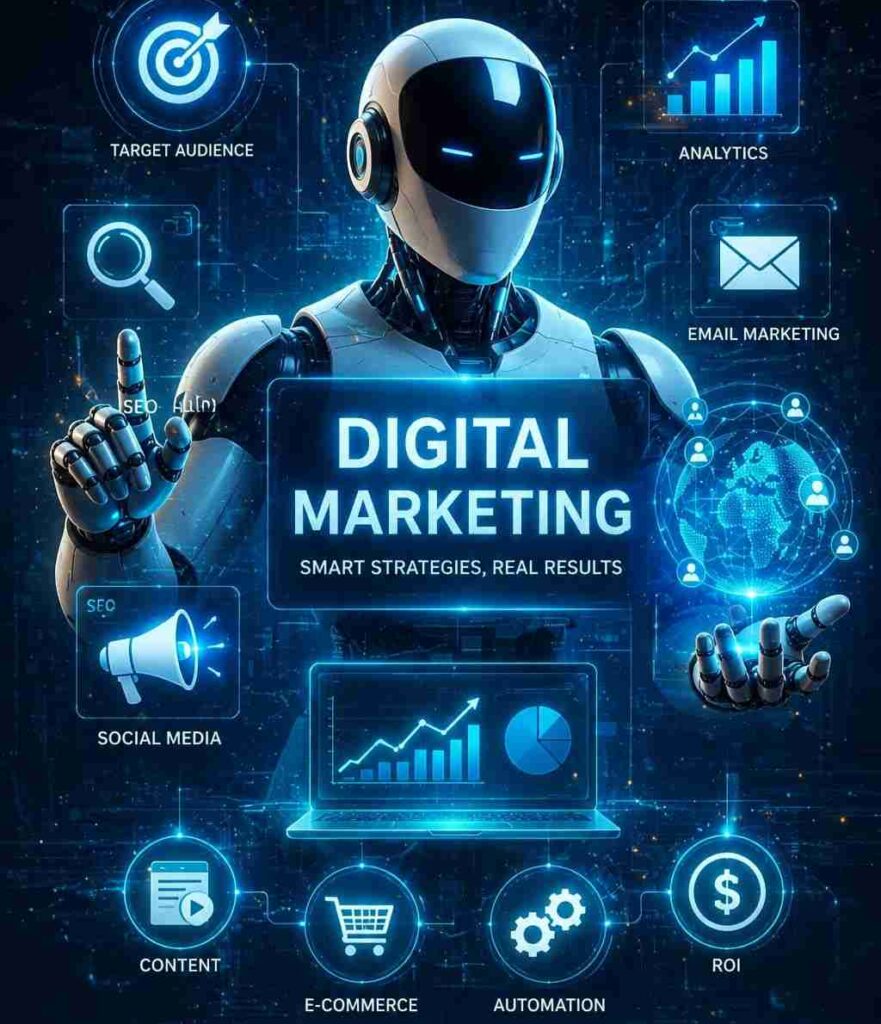
AI in Digital Marketing: How Artificial Intelligence Is Revolutionizing Marketing
Never before has digital marketing seen such a dynamic phase as the present day. Organizations prepare content, conduct their advertising, connect to their customers, and handle their data every day in different digital channels. This consumes much time. Here comes in handy the role of Digital Marketing AI.
Artificial Intelligence helps in analyzing customers, automation of processes, creation of new content ideas, dealing with large amounts of data and enhancing ad campaigns. However, there is no question that artificial intelligence is not aimed at replacing people. Rather, it is aimed at helping people work smarter and make informed decisions.
Knowledge of how AI works in marketing will come in handy for businesses of any size.
What Is AI in Digital Marketing?
Definition of AI in Digital Marketing: It is the implementation of various types of artificial intelligence technologies to enhance the marketing process.
An AI system can deal with vast amounts of data, recognize patterns, create content, predict consumer behavior, and automate some operations. These opportunities may be employed by marketers in such spheres as SEO, social media marketing, email marketing, advertising, customer service, and content generation.
For instance, a business running on the Internet can use AI to identify what products may be appealing to a specific customer. The same can be done by the marketing department as well.
It is essential to know that AI must help in forming a marketing strategy and not replace it.
Why is AI becoming increasingly important in marketing?
First of all, in the contemporary reality, the customer expects that the brand should offer him a relevant experience instantly.
Secondly, nowadays, the marketing personnel has much more data available, along with digital touchpoints than ever before.
And AI may help companies operate in this environment.
The possible advantages might include the following:
* Time saving for routine work
* Personalization
* Brainstorming
* Marketing automation
* Trend detection
* Decision-making
* Enhancement of the customer experience
Proper use of AI in digital marketing tools will enable marketers to save their time for routine activities and focus more on creativity.
1. AI Is Changing How Marketers Create Content
Even though content is still an important part of Ai in digital marketing, the task of creating content regularly is not easy.
AI-driven tools can assist marketers in finding topics to write about, creating outlines, writing draft texts, summarizing information, and rewriting texts to fit particular platforms.
The marketers can generate the following types of content from one full-fledged piece of writing:
* Email texts
* Videos ideas
* Captions
* FAQ (Frequently Asked Questions)
But there is one thing that AI-driven content creators should never do: publish their texts without any revisions.
Human marketers should fact-check, make insights of their own, understand their audience, and make sure that the content sounds like them.
The best scenario is AI in digital marketing -assisted content creation.
2. AI and SEO
SEO is another sphere where artificial intelligence is having an impact on Ai in digital marketing.
Here, AI-based technologies can assist marketers in performing such actions as:
* Keyword research
* Intent of searches analysis
* Planning of content
* Research of competitors
* Optimization of content
* Detection of topic gaps
* Website performance analysis
Since AI technologies are capable of processing great volumes of information rapidly, they help marketers find some patterns in the information that may require lots of time to be found manually.
Nonetheless, SEO does not solely revolve around filling the article with keywords. It needs to deliver to its users something that would be both useful and relevant.
Thus, marketers must be interested in producing useful, relevant, original, and readable content.
3. Personalized Experience for Consumers
Another important advantage of applying AI in digital marketing technology to marketing is the personalization that comes with this approach.
As opposed to addressing everyone with just one message, firms can use their marketing strategy in a personalized way through gathering information that will enable them to understand the customers better.
To illustrate, an online retailer may personalize its recommendations depending on past interactions on the website or purchase behavior.
The AI in digital marketing system can also enable marketers to segment their audience according to criteria including but not limited to:
* Interests
* Past purchases
* Online behavior
* Geography
* Customer engagement
* Preferences
4. Chatbots and Customer Support Using AI In Digital Marketing
Whenever the customers connect with the organization via the Internet, their first requirement is getting an instant response.
An AI-powered chatbot can be utilized to respond to some of their queries, provide them with some information, guide them through the website, and do some of the tasks associated with customer support.
Below are some examples of the type of questions a chatbot can handle:
* Working hours
* Availability of products
* Shipping details
* Appointments
* Frequently asked questions
Chatbots can prove effective in addressing recurring questions; while the more complicated queries have to be managed by human operators.
5. The Role of AI in Social Media Marketing
The use of various social media tools may require spending lots of time on that.
AI tools may assist marketers in measuring engagement, generating content ideas, spotting trends, writing captions, and scheduling.
AI tools may also help businesses understand which type of content is more effective among their target audience.
For example, if informative videos bring more engagement than other types of posts, businesses will know that they have to produce more videos.
However, the social media marketing platform involves communication. The messages that have been created by the use of artificial intelligence will be predictable in nature unless reviewed and updated.
Creativity and truthfulness should always be kept in mind.
6. AI and Digital Advertising
Paid advertising produces significant volumes of data. It is essential for marketers to be aware of impressions, clicks, conversions, audience behaviors, and costs of advertising.
AI can be utilized for analyzing data and uncovering patterns.
The AI-based advertising platforms can facilitate the following activities:
* Audience targeting
* Ad optimization
* Analysis of performance
* Budget management
* Predictive modeling
* Creative testing
Marketers would be able to make decisions faster and efficiently.
However, it would be better for marketers to track their marketing campaigns regularly rather than leave everything to automation.
7. Predictive Analytics and Customer Behavior
In the conventional sense of marketing, it has always been more concerned with understanding the customer’s previous behavior.
However, with the help of AI technology, marketers can go one step ahead of their customers by trying to find patterns for future behavior.
Predictive analytics could be useful in making predictions regarding:
* Repeat buyers
* Potential converts
* Product demand
* Customers likely to discontinue interaction
This would help marketers in making better decisions.
The accuracy of predictive analytics will depend upon the relevance of the data involved, so organizations should not take AI generated predictions for surefire.
8. AI In Digital Marketing Automation
There are numerous repetitive activities associated with AI in digital marketing.
AI and automation may prove useful in performing repetitive workflows, which include:
* Email marketing campaigns
* Audience segmentation
* Lead follow-up
* Content scheduling
* Campaigns performance reporting
* Customer engagement
While automation can be beneficial in terms of saving time for smaller businesses with limited marketing departments, it is not necessarily about automating everything. Repetitive workflows that can be optimized with automation must be identified.
Advantages and Disadvantages of Using AI in Digital Marketing
While there are several advantages in using AI in marketing, there are also disadvantages associated with the technology.
Advantages
* Fast analysis of data
* Efficiency in marketing
* Personalization
* Elimination of repetitive tasks
* Gaining insights into marketing campaigns
* Creation of fast ideas for content
* Scalability in marketing
Disadvantages
* Misleading information or data from AI
* Data privacy problems
* Lack of creativity by humans
* Over-automation
* Bias in data and algorithms
* Humans need to verify the information
* Integrity of brands
Implementation of AI in Your Business
It is not mandatory for you to implement AI in all parts of your business from the beginning itself.
Instead, try implementing AI in one or two areas in your business that can make a difference.
For example:
Step 1: Identify a repetitive process in your marketing processes.
Step 2: Choose an AI technology that fits the job.
Step 3: Implement the technology on a pilot basis.
Step 4: Evaluate the quality of the output.
Step 5: Compare the output with that of your existing process.
Step 6: Implement the technology on a wider basis if there is a difference.
Most importantly, get involved yourself in making decisions.
AI in Digital Marketing in the Future
As AI technologies evolve, AI will most probably become a more common aspect of digital marketing. Marketers will have access to new tools related to personalization, automation, analytics, creation of content, and customer experience because of these technologies.
However, technology alone does not lead to the success of marketing campaigns.
Companies will require creativity, strategy, empathy, good communication skills, and customer knowledge.
Therefore, the future of marketing will probably not be about AI vs. people but rather about marketing that involves humans and AI.
Conclusion
AI in Digital Marketing is reinventing the methods of gathering insights, creating content, analyzing data, automation, and optimization.
Whether it be search engine optimization (SEO), social media marketing, ads, chatbots, personalization and prediction, all that is what AI will help marketers to do in order to make decisions based on data and optimize their workflow.
However, one has to remember that AI is only a tool to be used and not a substitute for human skills and abilities.
Those businesses that will be able to combine AI technologies and their own skills and customer insight will be able to handle all the challenges of the digital world.
The magic phrase here is “Use AI to do smarter things”.